Cranbrook Academy of Art
The founder of Cranbrook Academy of Art, George G. Booth, invited Eliel Saarinen to create and develop a multidisciplinary art academy and campus at Cranbrook, Bloomfield Hills in Michigan. The Saarinen family moved to Bloomfield Hills in 1925, thus launching Eliel's career in the United States. He also served as the academy's President from its beginning in 1932 to 1946.

George G. Booth had visited the American Academy in Rome in 1922, which inspired him to develop an art education community where artists and scholars could gather for informal creative activity.
The concept of an art academy gradually took form in the late 1920s and mid-1930s, evolving into a collection of workshops across various artistic disciplines. Following the artist-in-residence principle, an architect, a painter, a sculptor, and a designer were permanently based at Cranbrook. In addition, visiting artists would take up residence in Cranbrook.
The Academy of Art officially commenced its activities in 1932, with Eliel Saarinen appointed its President. He held the position until 1946, while also heading the Department of Architecture.
Carl Milles, on the invitation of Saarinen, played a significant role in creating the sense of a total work of art for the Cranbrook area, his sculptures becoming a characteristic feature of all the building groups.
The construction of the Academy of Art began slowly and progressed in stages. The first Architectural Office was completed in 1926, designed by J. Robert F. Swanson and Henry S. Booth with Eliel Saarinen serving as advisor. George G. Booth commissioned Saarinen to design the artists’ apartments and workspaces in 1928, and construction began that same year. The first studios were compact spaces or workshops.
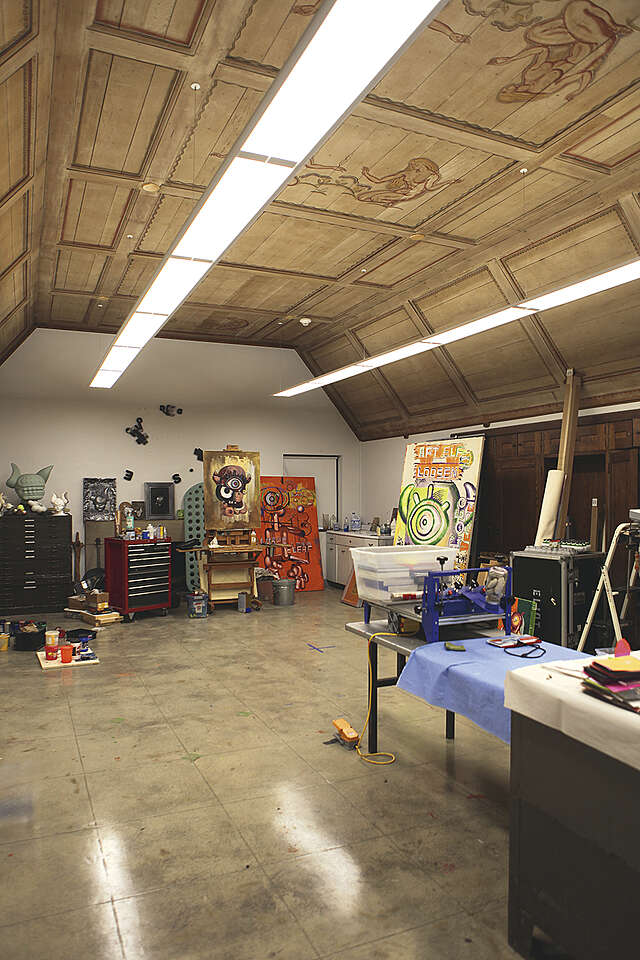
Studios for weaving and textile design, for cabinetwork, silverwork, ironwork, bookbinding and book printing were completed in 1931. The interiors of these studios were adapted to their specific functions: for example, the iron shop had exposed brick walls and wooden roof structures as did the sculpture studios, whereas the bookbinding and printmaking rooms had panelled walls. Large windows ensured ample natural light for the fine art and sculpture studios.
From the Academy Way gateway the construction proceeded northward. By 1936, the women’s dormitory was completed, followed by the faculty residences, dormitory and painting studio in 1938. The street is lined with gabled buildings, the earliest of which boast red brick exteriors and slate roofs. The front yards along the tree-lined street are enclosed by low walls.
The raised entrances of the buildings are accessed from the street via staircases. The buildings completed in the late 1930s have a simpler façade design, marked by a change in materials, from red to tan brick on the façades and from slate to copper on the roofs. The completion of the Academy of Art complex was marked by the inauguration of a museum and library building in 1942, also designed by Eliel Saarinen.
Abridgement of original text by Sirkkaliisa Jetsonen in Eliel Saarinen Public Buildings (Rakennustieto 2024).
The inclusion of this project was supported by the Finlandia Foundation.

Gallery


Location
39221 Woodward Ave, Bloomfield Hills, Michigan, USA
Get directions


