Christ Church Lutheran
The church was to be the last building Eliel Saarinen completed. It has been described as a breakthrough in modern architecture for sacral buildings in the United States. Eliel's son, Eero Saarinen, designed an extension to the church, the Education Wing, completed in 1962.

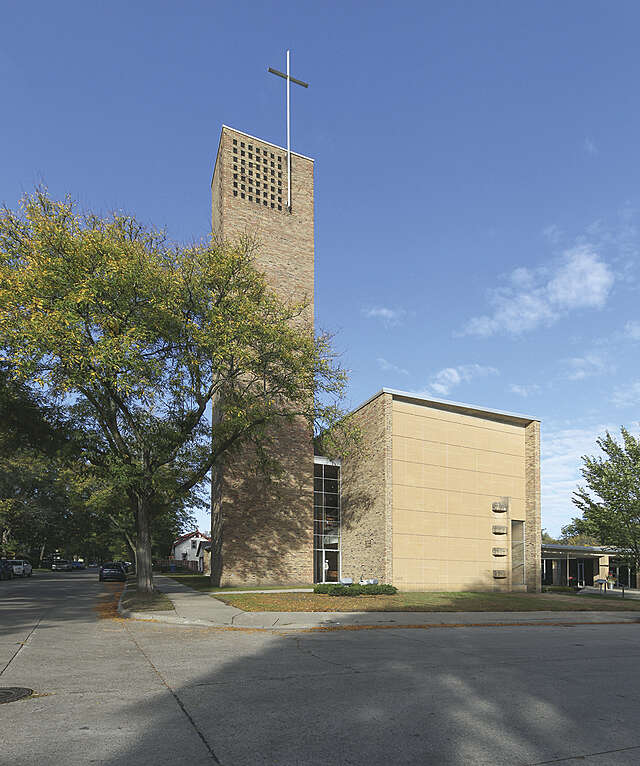
The original church building comprises the main church hall, a chapel at the rear directly connected to the hall, and the sacristy. The bell tower at the corner of the street is a local landmark, with a slim metal cross accentuating its height. Connected to the church by a glass gallery, the tower is visually detached from the main volume.
The main façade, comprising warm yellowish brick and limestone, is solid, featuring only one vertical window illuminating the chapel. Its focal point is a series of reliefs by the artist William McVey, symbolising the importance of the church to the community. Behind the brick exterior, the load-bearing structures are steel.
The main entrance is on the side of the building, under an arcaded canopy. The church hall opens on the side of the vestibule, narthex. Its layout is traditional and clear, with a high nave and low aisles. However, one of the nave’s wall and pillar lines is slightly angled, creating a tapering space that places the altar in the centre of attention. The most intense natural light falls on the altar from a tall west-facing window on the side, concealed in a recess. A high wooden screen limits the view towards the window.
In the altar area, the yellowish brick surface is lightly white-washed, making the wall in that section stand out slightly lighter than the rest of the space. The furniture combines timeless travertine on the altar table with the contrast of modern aluminium for the cross on the wall and the candlesticks. The pulpit is panelled with white oak. The wooden cladding on the aisle walls and the wooden furniture add a touch of warmth. The pews are made of oak.
The chapel space at the rear of the church hall echoes the themes of the main space: the strong sidelight falling on the altar and the natural stone of the altar table.
The acoustic properties of the space were carefully examined. One of the nave walls is straight, the other is gently undulating. The latter is also acoustically structured, with open brickwork splayed in and out.
Eero Saarinen designed an extension to the church, the Education Wing, which was completed in 1962. The main entrances of the buildings are connected by a street-facing arcade that also delineates a courtyard. Delicately flanking Eliel’s church, the single-storey extension’s façades facing the courtyard and the street are light and made of glass, providing a contrast to the brick-and-stone-dominated older building.
The Education Wing’s nearly square base is divided into zones. The courtyard side is flanked by a bright lobby corridor. Illuminated by a skylight, it extends towards classrooms at the heart of the building, their glass walls opening onto the corridor. At one end of the corridor is a multi-purpose, two-storey gymnasium. Meeting and club rooms are also located on the ground floor. The Luther Lounge on the street side is furnished with mid-century modern iconic furniture.
The church has been described as a breakthrough in modern architecture for sacral buildings in the United States. Designated a National Historic Landmark in 2009, the church is without precedent in ecclesiastical architecture because of its focused design, lighting, and acoustics.
Abridgement of original text by Sirkkaliisa Jetsonen in Eliel Saarinen Public Buildings (Rakennustieto 2024).
The inclusion of this project was supported by the Finlandia Foundation.

Gallery


Location
3229, 34th Avenue South, Longfellow, Minneapolis, Minnesota, United States
Get directions


