Raili Pietilä
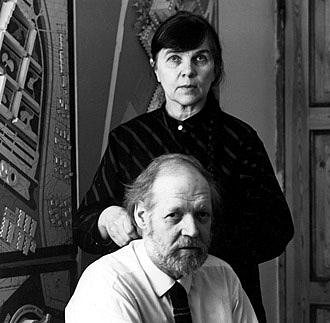
The architect couple Raili (née Paatelainen, 1926–2021) and Reima Pietilä (1923–1993) held throughout their career an exceptional position in Finnish architecture. Their projects were regarded far too original to fit into the “official” image of Finnish architecture and, consequently, they were often criticised for romanticism, impracticality and high costs.
Despite all this, the Pietiläs were able to realise several projects which today are considered among the classics of Finnish architecture.
In 1961, Reima Pietilä established a joint office with Raili Paatelainen. They married two years later, in 1963.
The Pietiläs’ joint career can be divided into three phases:
In the 1960s, they realised three major projects: Kaleva Church (1966) in Tampere, Dipoli building (1966) in Otaniemi, Espoo and the Suvikumpu apartment block (1969) in Tapiola, Espoo. These buildings were characterised by close contact with nature, bold sculptural forms and tactile details.
At the time, however, Finnish architecture evolved in the opposite direction, with emphasis on rationalisation, standardisation and prefabrication. Consequently, the Pietiläs’ office was almost without work for several years.
In the mid-1970s, the prevailing technocratic tendency began to attract more and more criticism, and the architect couple again received important commissions. The influence of international Postmodernism was evident in many of their projects, such as the Hervanta Central Axis (1979, 1989) in Tampere, the Sief Palace Area (1982) in Abu Dhabi, and the Lieksa Church (1982).
In the 1980s, the Pietiläs returned to organic forms typical of their early works while using more sophisticated materials and details. The major projects of this phase were the Finnish Embassy in New Delhi (1985), the Tampere Main Library (1986) and Mäntyniemi, the official residence of the President of Finland (1993) in Helsinki.
In recent years, Raili and Reima Pietilä’s architecture has attracted new attention as a result of new research, books, exhibitions and renovations of their buildings.
Text: Kristo Vesikansa


